

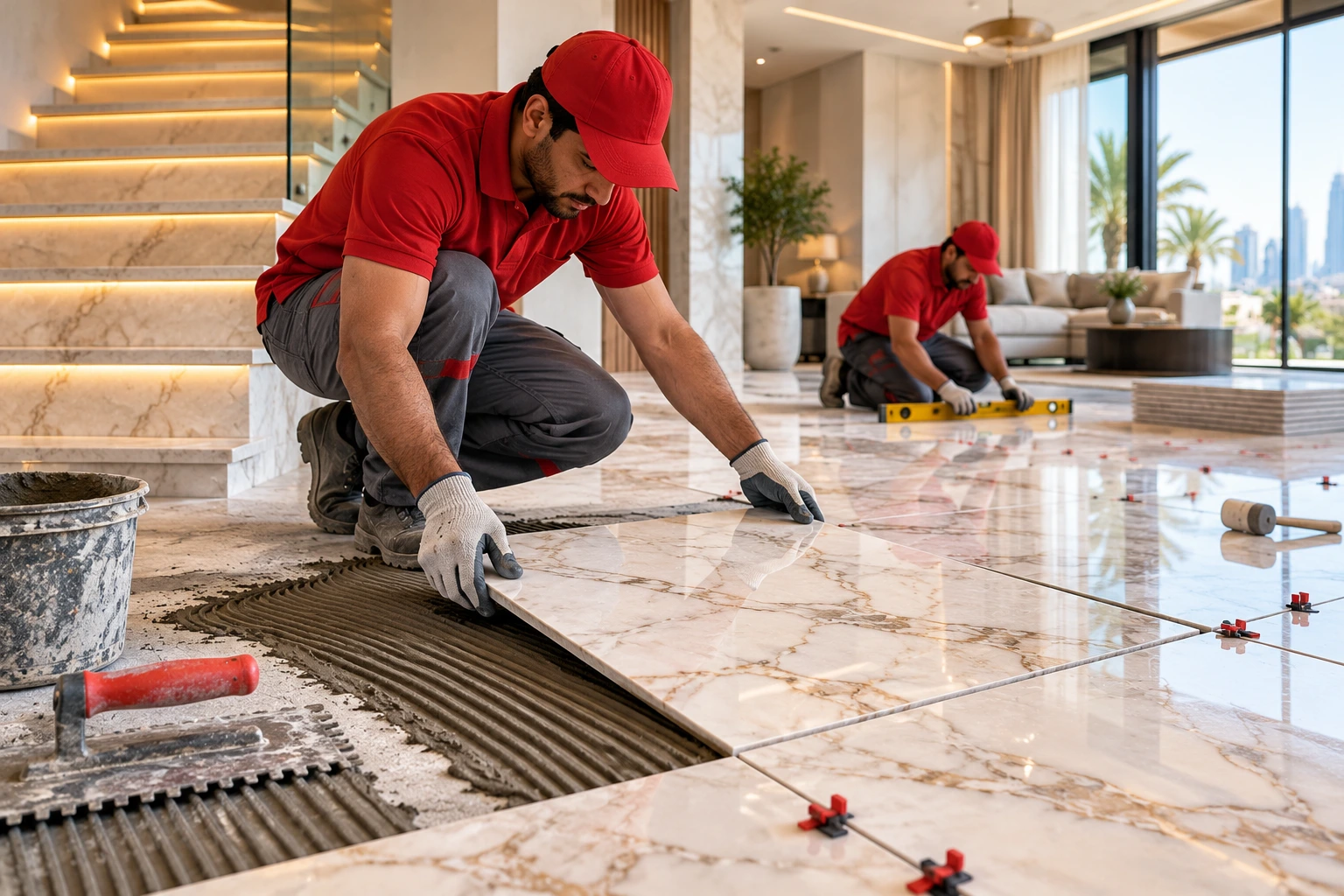
Professional Marble flooring installation in Dubai can add beauty and value to a property. Its visual appeal derives from natural veining and colour variations, with a broad range of available finishes. But how far should a homeowner go to choose aesthetically pleasing, high-quality marble? The answer covers everything from inspecting the floor area to hiring the right installation professionals.
In short, marble flooring is elegant in appearance but demands experienced craftsmanship to achieve the desired results. This guide will cover marble flooring installation in Dubai in detail, including preparation, materials and finishing touches. We will also discuss the costs, potential mistakes and questions to ask a flooring contractor.
How Is Marble Flooring Installation in Dubai?
Professionals typically follow standard procedures for marble flooring installation, which includes inspecting and measuring the area, choosing suitable stone, preparing the surface, planning the layout, installing setting materials, placing the marble and completing joints and finishing operations.
The manner in which marble is installed depends on its properties, size and format, as well as the condition of the underlying surface. The Natural Stone Institute’s Dimension Stone Design Manual, for example, provides information on natural stone selection, installation methods and finishing options.
Let’s take a closer look at flooring installation for marble in Dubai.
Step-by-step Installation Process for Marble Floors
1. Inspection and Measurement of the Floor Area
Before any stone is placed, a flooring contractor conducts a site inspection and uses measuring equipment to obtain the exact dimensions of the area. At this stage, the contractor can also assess the general condition of the floor, paying particular attention to unevenness, damaged finishes and potential problems during preparation works.
It is also necessary to inspect door frames, skirtings, thresholds and transition details between different areas or rooms. For instance, floor height differences may dictate the type of door hardware in an apartment. By contrast, a villa may involve large uninterrupted spaces that call for extra planning regarding transitions and movements.
2. Selection of Suitable Marble Flooring
Natural stone is diverse in terms of colour, veining patterns and other qualities. Therefore, it is advisable to learn about the differences between polished and honed finishes and other options, and the intended location of marble items, whether they are slabs, tiles or curving features.
Not all marbles are equal in terms of quality and appearance. Some variations are highly resistant to staining, while others change colour when exposed to certain substances. Make sure to observe the samples provided by the seller under different lighting conditions, not only in the store.
While an elegant living room or bedroom can accommodate large-format marble flooring, narrow strips above doorways and around windows appear more restrained and balanced.
3. Determining the Scope of Works and Requirements
Before the flooring contractor prepares a quotation, it is necessary to clarify the scope of works. Does the existing floor covering need to be removed? Are there any repairs to the underlying surface? Or are there other requirements, such as new skirtings and thresholds? Building regulations are another consideration.
According to Dubai Development Authority’s Circular 318, certain types of flooring replacements fall under the category of landlord or facilities-management approvals rather than DDA fit-out permits. The document also specifies technical requirements and other conditions. Note that this is not a general requirement for all real estate in Dubai.
For instance, an apartment owner may want to confirm whether the building regulations are applicable or not. As for villa owners, determining the scope of works is essential to avoid additional approvals for marble flooring.
4. Removal of the Existing Floor Covering
For a renovation project, the contractor usually removes the old floor covering. Therefore, prior to working on the new floor, the team will ensure that the area is cleared of obstacles and the existing materials are completely removed. It is advisable to take precautions to avoid damaging adjacent finishes. Once the old flooring is removed, the contractor can examine the underlying surface more closely.
In many cases, a closer inspection can reveal issues that were not visible during the initial survey. While the condition of the sub-floor may still be acceptable, some imperfections may affect the new floor covering. It is unwise to place marble flooring on an unsuitable substrate with the expectation that it will remain in good condition for years.
5. Preparation of the Underlying Surface
Subfloor preparation is one of the critical stages in flooring installation. Depending on the intended use, the surface must be durable enough to support the selected stone, tiles or other floor covering. It also needs to be clean and sufficiently flat. Note that a completely level floor is not always necessary, and the degree of flatness depends on the intended finish and system of installation.
The Tile Council of North America (TCNA) Handbook for Hard Surface Flooring includes specific requirements for subfloor preparation and flatness in the case of stone and tile flooring. In some instances, contractors may need to make repairs to the subfloor or use a particular system for site preparation.
It is also necessary to ensure that the moisture content is suitable for the proposed floor covering. Failure to complete this step properly can have a negative impact on the newly installed marble floor.
6. Finalising the Design and Layout of Marble Flooring
Since natural stone is not entirely uniform in terms of colour and veining, it is advisable to make sure that the pattern will be consistent throughout the area. One of the contractor’s responsibilities is to plan the marble layout, which will create the illusion of uniformity, especially if veining is visible.
It is important to leave sufficient space near doorways, windows and other openings. For some variations of marble, the orientation of the pattern can make a noticeable difference. In some cases, it may be possible to use book-matched marble or similar options.
7. Selection of Suitable Setting Materials
Setting materials are essential for any flooring system since they ensure proper adhesion and minimise the risk of cracks, chips, stains and other issues. The choice of setting materials depends on the properties of the stone, including its colour, dimension, format and thickness, as well as the intended use of the area.
For instance, some light-coloured marbles may require white setting materials to prevent discolouration. In the case of moisture-sensitive marble, a specialist system may be necessary. It is advisable to follow the recommendations of the stone supplier and setting material manufacturer.
8. Installation of Marble Flooring
Once preparations are complete, the contractor can begin installing marble flooring. Depending on the system of installation, the team will apply setting materials and place stone slabs or tiles. Throughout the process, the contractor will make adjustments to ensure that the materials are placed correctly and consistently. Since marble slabs can be fragile, special care must be taken to avoid cracks and other damage to the edges and surface.

Lippage, or unevenness of adjacent pieces, is another issue that requires the contractor’s attention. According to the TCNA Handbook, lippage is affected by subfloor preparation, individual variations in materials, and the skill of the flooring professional. Thus, it is vital to make sure that the contractor does not leave this step until the end of the installation.
9. Completion of Joints and Movement Joints
After setting materials are ready, the flooring contractor proceeds to complete joints and movement joints. The choice of grout depends on the properties of marble and the system of installation. The contractor should also make movement joints, which are necessary for certain types of flooring. They allow the floor to expand and contract, minimising the risk of cracks and other damage.
The TCNA Handbook highlights the importance of movement joints in tile installations, particularly in areas with high moisture content or direct exposure to sunlight. Not all movement joints are the same, and it is not advisable to use grout in every gap.
10. Cleaning, Finishing, Polishing, and Sealing of Marble Flooring
Finishing operations can vary depending on the type of stone, system of installation and other factors. Some marble flooring systems require minimal aftercare, while others need to be polished or treated. The chosen contractor should complete all finishing works in accordance with the requirements of the materials.
As for sealing, it is important to remember that impregnating sealers improve the stain resistance of natural stone but do not render it completely immune to damage. The Natural Stone Institute advises against using the same products for all types of marble. Instead, homeowners should consult the supplier regarding suitable sealer products and the timing of this operation.
11. Final Inspection of the Installed Floor Covering
Prior to completing the works, the contractor should conduct a general inspection of the installed marble flooring. It is necessary to ensure that all pieces fit together correctly and that there are no obvious defects, such as cracks or unevenness.
The choice of marble allows for individualisation, but it should not deviate significantly from the initially selected pattern. The contractor can also highlight the details that require special care and attention. In most cases, it is advisable to wait before placing any objects on the floor. The curing time depends on the type of materials used in the flooring system.
Cost of Marble Flooring Installation in Dubai?
The cost of marble flooring depends on several factors. First of all, the type of marble, its size, thickness and surface profile determine the material cost. Next, the existing floor covering and its condition influence the extent of preparation works. The layout of the new floor also affects the overall price since some patterns require more precise measurements and cutting of marble slabs or tiles.
Other considerations include the presence of additional structures, such as stairs, and the need for polishing, sealing or other finishing operations. Thus, it is unwise to rely on an approximate cost per square meter or square foot. Instead, it is advisable to request a detailed quotation after the contractor conducts a site inspection. It is also essential to clarify whether the quotation includes all costs, from materials to labour.
Common Mistakes During Marble Flooring Installation
There are several mistakes that can occur during marble flooring installation. Many of them are related to surface preparation. In some cases, homeowners can use marble slabs or tiles of different sizes and shapes without considering the effect of these choices on the overall appearance.
A flooring contractor who ignores this factor will not be able to produce consistent vertical lines and uniform placement of individual pieces. Another common error of flooring contractors is the choice of setting materials, which affects the integrity of the new floor covering. Failure to plan the layout of marble tiles, slabs or other floor covering also leads to unsatisfactory results.
Lastly, it is a mistake to rely on the same cleaning and maintenance products for all types of marble.
How to Maintain Marble Flooring?
In most cases, marble flooring requires regular cleaning and occasional polishing. A vacuum cleaner or similar equipment can remove loose dust and sand. As for other cleaning materials, it is advisable to follow the recommendations of the Natural Stone Institute. Acidic substances, including vinegar or citrus-based cleaners, are not suitable for cleaning marble, limestone or travertine.
These materials contain calcium carbonate, which reacts with acidic components. Spots, streaks and fingerprints should be cleaned with appropriate products, ideally those recommended by the stone supplier. Thus, regular maintenance is a more convenient option than trying to repair marble damage after it occurs.
Why Choose Alaizal Technical Services for Marble Flooring in Dubai?
Alaizal Technical Services helps residential and commercial property owners in Dubai with technical services and flooring renovations. The quality of marble flooring is determined by a combination of materials and workmanship. From this perspective, hiring a reliable contractor is no less important than selecting marble slabs or tiles of high quality.
Alaizal Technical Services can provide advice on all aspects of flooring, from choosing suitable materials to completing finishing works. Whether you own a villa or an apartment, you can benefit from a flooring contractor who understands your vision and ensures that all details comply with the design. We provide complete home renovation services in Dubai. Use our technical services for your residential or commercial property in Dubai and enjoy the beauty of marble flooring.
Final Thoughts
Marble flooring is a desirable aspect of any residential or commercial property in Dubai. However, choosing marble flooring involves more than picking a beautiful slab or tile. An experienced contractor will take into account the existing floor covering, select the appropriate setting materials and make adjustments to the layout.
Additionally, a flooring professional will advise on the choice of marble, based on the location and expected load-bearing capacity. Alaizal Technical Services can assist you in ensuring that marble flooring meets your expectations.
Frequently Asked Questions
How long does marble flooring installation take in Dubai?
The timeline depends on the floor area, preparation work, stone dimensions, layout complexity and curing requirements. A contractor can provide a more reliable schedule after inspecting the site.
Can marble be installed over existing tiles?
Some installation systems may allow this when the existing surface is sound and meets the system’s requirements. However, height, adhesion, moisture and substrate conditions may make removal necessary.
Does marble flooring need sealing?
Some marble benefits from an appropriate impregnating sealer, while other stones may not require one. Follow the supplier’s guidance. Sealing improves stain resistance but does not prevent every stain or etch mark.
Is polished marble suitable for every room?
No. Finish selection should reflect the room’s use, moisture exposure and slip-resistance requirements. Highly polished finishes may not suit every wet-area application.
Can marble flooring be polished after installation?
Yes, certain installations can receive professional polishing or refinishing. The appropriate method depends on the marble and its existing finish.
Get a Marble Flooring Quotation in Dubai
Planning new marble flooring for your villa, apartment or commercial property?
Alaizal Technical Services can help you review your flooring requirements, discuss suitable materials and arrange a site inspection.
Call or WhatsApp: +971 56 787 9063
Website: https://alaizaltechnicalservices.com/
Request a clear quotation before starting your marble flooring project.
