

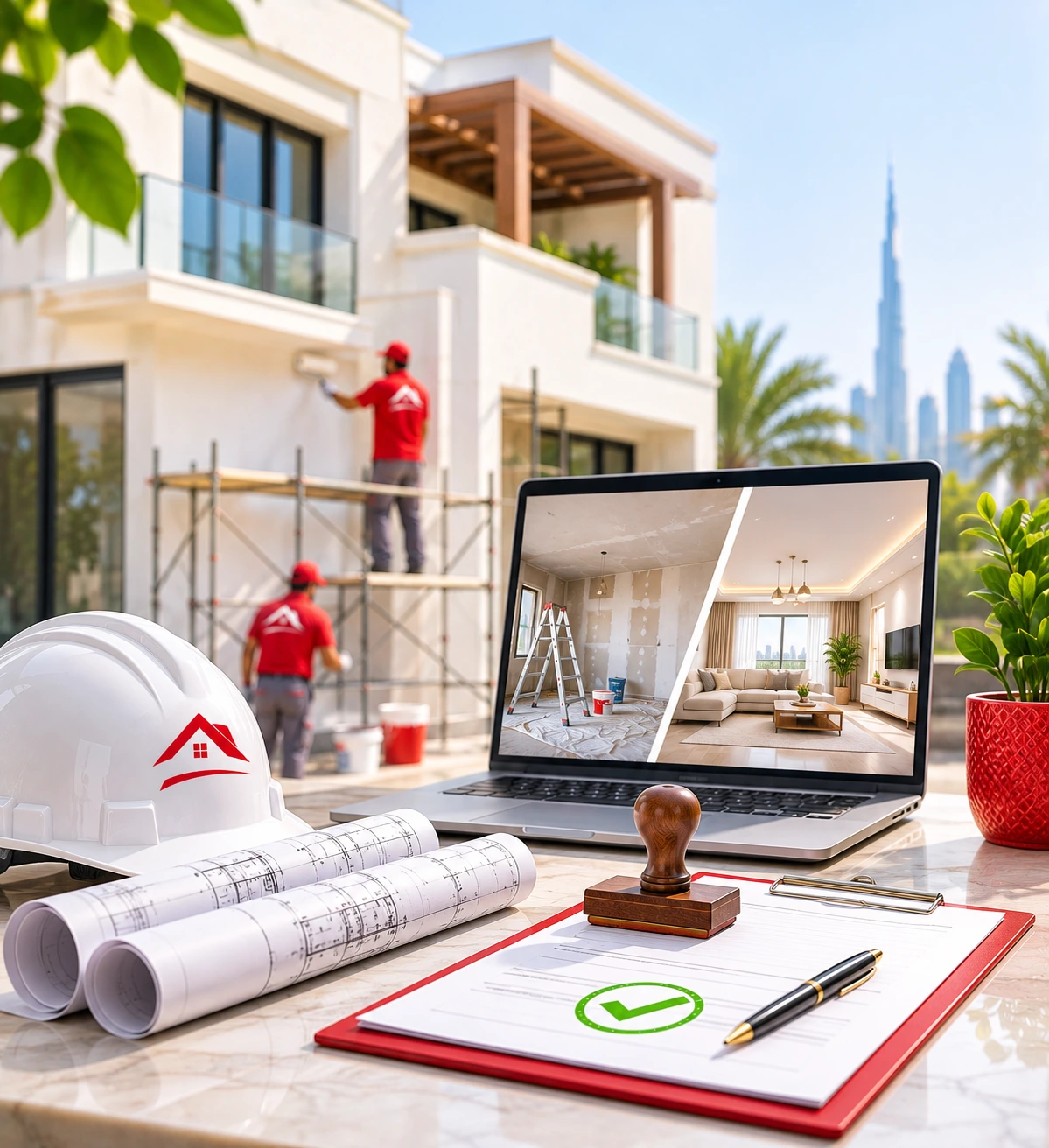
It is important to understand the Dubai Renovation Permits associated with property renovation. Various permissions may be needed for both domestic and commercial properties including those from the government, developer, property landlord and for health and safety as well as for the type of work being carried out. People choose to renovate to enhance a property’s aesthetics, function and desirability. An absence of knowledge of Dubai’s legal procedures can result in extra costs, delays and even legal issues.
Even an apparently uncomplicated renovation can become more complex if it entails rewiring, demounting and/or redecorating. Whether you are seeking to enhance your property slightly or are embarking on a more in-depth renovation, this legal guide will provide information on the necessary permissions and actions to take in order to successfully manage your renovation.
Do I Need Dubai Renovation Permits for My Property Renovation?
Depending on the nature of your property renovation, you may not always need a full construction permit. Simple enhancement works can sometimes just need either building management or community works permission. More substantial structural and technical renovation would however typically require permission.
Requirements will vary depending on:
- Where your property is and which jurisdiction it is within.
- The nature of the renovation.
- Whether there are structural changes.
- Developer and community regulations.
- Alterations to the mechanical, electrical and plumbing systems.
- Whether the property is domestic or commercial.
Prior to engaging a contractor and purchasing resources, you should therefore ascertain the appropriate permissions for your proposed renovation. In Dubai, expert domestic renovation contractors can advise you regarding the nature and technicality of your planned renovation.
Which Renovation Works Require Dubai Renovation Permits?
Renovation projects generally fall into three categories: cosmetic improvements, technical modifications and structural alterations.
| Renovation Work | Typical Approval Considerations |
| Interior wall painting | Building management permission may apply |
| Flooring replacement | Community rules and flooring specifications |
| Kitchen cabinet replacement | Minor works permission may apply |
| Bathroom fixture replacement | Depends on plumbing modifications |
| False ceiling installation | Additional review if building services are affected |
| Electrical system upgrades | Technical approval where applicable |
| Plumbing relocation | Building management and technical approvals |
| AC system modification | Mechanical and building management requirements |
| Structural wall removal | Formal approval and engineering assessment |
| Villa extension | Building permit and relevant developer approvals |
| Exterior façade modification | Community and relevant authority approval |
| Swimming pool construction | Property-specific construction approvals |
| Commercial office fit-out | Landlord, fit-out and relevant technical approvals |
| Change of property use | Formal planning and building approvals |
These are general planning considerations rather than universal permit classifications. Always confirm the requirements with the authority responsible for your property.
Who Approves Property Renovations in Dubai?
In Dubai, a number of entities and bodies manage different areas of property renovation and construction.
Dubai Municipality (DM)
This entity manages building regulation and construction related services in Dubai. It handles matters such as building adaptations, extensions and repairs as well as a range of construction related permissions. Those wishing to make substantial structural changes should investigate whether these will require DM approval. Information about building and construction related services can be found on the DM website.
Dubai Development Authority (DDA)
This is charged with managing construction and development in defined areas. Depending on the nature of a renovation, the following types of permissions may be needed – building adaptation, fit out, amended designs and completion. Under particular circumstances, limited fit out works can be exempted but only upon complying with DDA regulations and having received permission from a property’s landlord and/or facilities management.
Trakhees
This body manages construction and adaptation in its jurisdiction. Properties within its jurisdiction may need to gain permission for adaptation before commencing either construction or fit out. Moreover, selected decorative works can be exempted provided that appropriate conditions are met.
Dubai Electricity and Water Authority (DEWA)
If electricity or water services are being adapted as part of a renovation then DEWA regulations may apply. Such works may consist of increasing electrical power provision and/or establishing or altering electricity and/or water supply links.
Dubai Civil Defence (DCD)
Fire safety is especially crucial for commercial fit out, restaurant and retail properties and for where fire services are altered. Appropriate permissions may be necessary for adapting fire alarm, sprinkler and/or evacuation systems and other fire safety equipment.
Property Developers and Building Management
Within developer managed communities (for example, those run by Emaar, Nakheel and DAMAC), community specific renovation regulations can exist. These can stipulate rules around a property’s external appearance together with constraints in relation to contractor access, working times and the transport and removal of resources.
Whilst government permissions may be obtained, these do not always supersede property developer and/or building management permissions.
What is an NOC for Property Renovation?
An NOC is a document verifying that an entity has no objections to specific work being undertaken, given particular conditions are met. For property renovation, an NOC can be issued by a property developer, landlord, building owner, facilities management and/or relevant authority.
Depending on your property, you may need to provide:
- Evidence of property ownership or tenancy.
- Details of the nature of the property renovation.
- Contractor information and their trade licence.
- Current and intended property floor plans.
- Technical drawings where appropriate.
- Estimated renovation timeframe.
- Evidence of insurance cover or deposit where necessary.
Generally, an NOC corresponds to the scope of work for which it was applied. If the renovation scope changes significantly, further permissions or updated paperwork may be needed.
Essential Documents Required for Property Renovation: Procedures can be stream-lined by compiling relevant paperwork at an early stage.
Ownership and Identification Documents: Depending on what is needed, you may need to present title deeds, Emirates ID, a copy of your passport and/or a tenancy agreement or Ejari registration. As a tenant you should also ensure that you have written permission from your landlord.
Architectural Drawings: These demonstrate a property’s current configuration and the envisaged changes. They may illustrate new walls, room divisions, doors, kitchens and bathrooms together with measurements.
Structural Engineering Drawings: Where structural adaptation is part of a renovation, specialist engineers may be engaged to produce structural drawings and calculations. Such information is used to analyse how structural elements including beams, columns, walls and slabs will be impacted by the planned renovation.
MEP Drawings: Mechanical, electrical and plumbing drawings highlight how a property’s core services will operate post-renovation. These can display:
- Electrical and illumination systems.
- Water and drainage.
- Air conditioning and ventilation.
- Adaptations to fire services.
- Placement of equipment.
- Access to services.
Expert MEP contractors in Dubai can advise on fulfilling technical requirements so that suitable action can be taken prior to renovation work starting.
Contractor Documentation: Authorities and/or building management may ask for evidence that a contractor possesses a valid trade licence, along with relevant registrations, appointment information and insurance data. Always ensure that a contractor has the right permissions for the work they are to undertake.
Step-by-Step Legal Checklist for Renovating Property in Dubai
Step 1: Define Your Renovation Scope
List precisely what you wish to alter. Clearly distinguish enhancement, structural and technical work. For instance, redecorating a living area is very different to dismantling a wall to form an open plan area. Establishing your renovation needs assists in cost evaluation and in identifying the relevant permissions. It also enables you to effectively compare contractor quotes.
Step 2: Identify the Relevant Authority
Identify which authority oversees your property or community. Before finalising renovation plans, contact either the relevant property developer, building facilities management or government department.
Step 3: Arrange a Professional Site Inspection
This can uncover a property’s structural state, outdated wiring, plumbing issues, dampness and other factors which might affect design. Issues can then be rectified pre-construction in order to minimise later alterations.
Step 4: Finalise Your Design and Budget
Specify a property’s configuration, resources, technicalities and finish. Ensure that your renovation budget includes provision for architectural drawings, permissions, surveys and deposits together with contingency for on-site variables.
Step 5: Obtain Landlord or Developer Permission
Present the pertinent paperwork and gain the required NOCs and/or work permissions. Review and consider any stipulations around noise, building access, working hours and common area usage.
Step 6: Submit Technical Documents and Permit Applications
Guarantee that the on-site workforce adheres to the approved renovation procedures. Appropriate examination should be conducted before implementing any structural, mechanical, electrical and/or fire safety related alterations.
Step 7: Execute Testing, Surveys And Project Completion
Arrange the requisite testing and surveys and then conclude your renovation. Ensure that copies are retained of approved architectural drawings, permissions, survey reports and project completion information for future reference.
Dubai Renovation Permits For Villa Renovations In Dubai
Compared to apartments, villa renovations frequently include more in-depth work. Residents of communities including Arabian Ranches, Dubai Hills Estate, The Springs, The Meadows and Palm Jumeirah should investigate what specific community regulations apply to them.
Special attention should be given to:
- Transforming property into an open plan area.
- Extending and adding to a villa.
- Adjusting external walls and façade.
- Creating pergolas and other external features.
- Installing a swimming pool.
- Converting a garage.
- Significant reconfiguration of kitchens and bathrooms.
- Enhancing electrical and air conditioning provision.
Despite fully owning a property, community, planning and building regulations can all impose limitations on the nature of a renovation. Expert villa renovation companies in Dubai can assist in devising a realistic renovation plan which takes these factors into account.
Dubai Renovation Permits For Apartment Renovations In Dubai
As Apartment Renovation occurs within a multi-residential property, there is a need for good inter-personal communication. Renovation electrical work in one apartment can impact that of another. Likewise, flooring can affect inter-storey acoustics. Prior to commencement of renovation work, investigate a property’s regulations covering:
- Contractor registration and access badges.
- Working hours.
- Booking of service lifts.
- Noise and dust management.
- Approved rubbish disposal methods.
- Preservation of communal passageways.
- Flooring and acoustics.
- Shared electrical and plumbing systems.
Never carry out communal building work without first gaining appropriate authorisation from the relevant management.
Dubai Renovation Permits For Commercial Properties And Offices
Beyond general property regulations, commercial properties need to conform to standards which facilitate business operations and staff wellbeing. Furthermore, they should be utilised in accordance with permitted property use. Commercial properties such as offices, restaurants and retail premises may need information about property occupation, mechanical, fire and evacuation systems together with electrical loading.
Restaurants can also face additional regulations relating to food hygiene, kitchen extract and drainage. Before deciding on a commercial property’s design, verify that the property is suitable for the intended business use. Professional Dubai office fit out contractors can help to harmonise aesthetic and technical aspects of an office environment.
Can Tenants Legally Carry Out Property Renovations?
Alongside acquiring permission from a landlord, tenants should also gain the relevant permissions. Dubai Law No. 26 of 2007 article 19 specifies tenants’ duties relating to property adaptation, repair and upkeep.
Prior to embarking on major renovation, tenants should ascertain:
- The nature of renovation which will be permitted.
- Who will finance the renovation?
- Whether fittings and/or enhancements can be retained.
- Whether the original property configuration must be reinstated.
- Who will apply for permissions?
Written documentation of these points will assist in avoiding potential disagreements at the end of a tenancy.
What Are The Costs Of Dubai Renovation Permits In Dubai?
There is no uniform cost for property renovation permissions across Dubai. It will vary according to the granting body, work area, renovation type and paperwork, in addition to community regulations.
| Cost Component | What It Depends On |
| Developer NOC | Community and renovation scope |
| Government permit | Authority and application category |
| Architectural drawings | Property size and design complexity |
| Structural engineering | Nature of proposed alterations |
| MEP documentation | Technical system requirements |
| Security deposit | Developer or building management policy |
| Inspection fees | Applicable approval process |
| Permit renewal | Validity period and project delays |
For example, the DDA specifies a fit out permit fee of AED 0.90 per square foot (with a minimum charge of AED 200 and a maximum of AED 10,000). Transaction fees will also be incurred.
Please note that this is only the DDA fee for a fit out permit and is not representative of all property renovation permission costs. Verify current fees for fit out permits on the DDA website so that you can effectively incorporate costs into your budget.
How Long Does Dubai Renovation Permits Take?
Permission duration will be influenced by factors including a renovation’s intricacy, the quality of associated paperwork and the number of bodies involved. Whilst a relatively uncomplicated renovation may be processed more swiftly than a villa extension which involves structural analysis, developer permissions and numerous technical examinations.
Whilst some authorities specify indicative timeframes for the processing of particular permissions, these do not usually include the period encompassing design, NOC and other permission applications. Your renovation timeline should thus be organised around confirmed permission availability rather than assuming that work can commence instantly.
Safety and Environmental Requirements During Renovation
It is important to ensure that a property renovation is conducted in a manner that safeguards the property, workers, residents and surrounding properties.
Important health and environmental factors include:
- Ensuring that emergency exits are accessible.
- Preserving existing electrical and plumbing systems.
- Managing construction generated dust and noise.
- Respecting working hour limitations.
- Effectively disposing of construction waste.
- Protecting communal areas and nearby properties.
- Complying with fire and building safety standards.
Special attention should additionally be paid to effective waterproofing, drainage, ventilation and electrical integration in relation to bathroom and kitchen renovations in Dubai.
What Happens If You Renovate Without Approval in Dubai?
Carrying out regulated renovation work without the correct permissions can give rise to various issues. Depending on the breach and the relevant granting body, ramifications may include a halt to renovation work, fines, supplementary examination, remedial action and/or the requirement to remove unpermitted changes.
Unauthorised structural work can also present difficulties in future property sales and/or technical analyses. Generally it is more effective to firstly acquire correct permissions for a renovation and then to conduct the work, as opposed to trying to retrospectively resolve legal issues.
Common Legal Mistakes to Avoid When Renovating:
- Starting demolition before confirming the approval requirements.
- Assuming developer permission replaces government approval.
- Hiring contractors without checking their relevant trade activities.
- Removing walls without assessing their structural function.
- Relocating plumbing without reviewing drainage arrangements.
- Changing approved designs without checking whether revisions are necessary.
- Ignoring community working hours.
- Failing to retain project documentation.
Avoiding these mistakes can help keep your renovation organised and reduce unnecessary expenses.
Why Choose Alaizal Technical Services for Property Renovation in Dubai?
Alaizal Technical Services provides coordinated renovation and technical solutions for villas, apartments and commercial properties across Dubai. From initial site inspections and clear quotations to MEP works, flooring, painting, carpentry and interior finishing, our approach focuses on practical project planning, quality workmanship and transparent communication. We help clients understand their renovation scope and relevant approval considerations before work begins, making it easier to plan improvements with confidence.
Explore our complete renovation and technical services in Dubai to find the right solutions for your property.
Frequently Asked Questions
1. Do I need Dubai Municipality approval for every renovation?
No. Requirements depend on the proposed work and property jurisdiction. Some minor improvements may not require a municipal building permit, although building management permission or another form of approval may apply.
2. Do I need an NOC to renovate my villa in Dubai?
Many villa communities require developer permission for renovation activities. Confirm the requirements with your community management before starting.
3. Can I remove an internal wall in my Dubai property?
Do not remove a wall until a qualified professional confirms its structural function and identifies the applicable approval requirements.
4. Do I need Dubai Renovation Permits to renovate my kitchen?
Replacing cabinets and worktops may involve limited approvals. Structural changes, plumbing relocation, electrical upgrades or ventilation modifications may require additional review.
5. Is painting a property in Dubai subject to Dubai Renovation Permits?
Routine interior painting generally involves fewer approval requirements than structural renovation. However, building management rules may apply, while exterior painting can be subject to community appearance restrictions.
6. Can I renovate my apartment without informing building management?
You should check building management requirements before starting. Even minor work may involve contractor access permissions, noise restrictions or other building rules.
7. Can I extend my villa in Dubai?
Villa extensions are subject to applicable planning, structural and building regulations. Obtain the required approvals before construction.
8. Do Dubai Renovation Permits expire?
Some permits have defined validity periods. Review your permit conditions and arrange renewal or extension where necessary.
Final Thoughts
Understanding the legal requirements for property renovation in Dubai is an important part of protecting your property investment. From defining the scope and obtaining applicable permissions to coordinating technical works and inspections, careful preparation can prevent many avoidable complications.
Whether you are refreshing an apartment, renovating a family villa or upgrading a commercial workplace, start with a clear plan, realistic budget and a reliable renovation team.
Planning a Property Renovation in Dubai?
Alaizal Technical Services offers residential and commercial renovation solutions with practical pricing, coordinated execution and attention to finishing quality. Request a site inspection, discuss your renovation requirements and receive a clear quotation before starting your project.
Call or WhatsApp: +971 56 787 9063
Website: alaizaltechnicalservices.com
