


Yes, marble flooring can be a good choice for Dubai homes, particularly for indoor areas where the environment is controlled. It offers natural variation, a refined appearance, and suitability for residential flooring. However, choosing marble should not begin and end with “Dubai is hot, so marble must be perfect.”
That would make renovation wonderfully easy. In reality, performance depends on where you install the stone, the marble variety, surface finish, installation quality, and how you maintain it.
Dubai also brings practical considerations such as sand and dust entering homes, strong sunlight near large windows, moisture in wet areas, and harsher exposure outdoors. So, marble can be an excellent flooring material, but it needs the right application.
Why Is Marble Popular for Flooring?
Marble is a natural metamorphic stone known for distinctive colours, veining, and pattern variation. The Natural Stone Institute identifies marble as suitable for applications including floors, foyers and bathrooms, while noting that many marble varieties can also suit wet-area applications.
One reason homeowners choose marble is simple: every piece can look slightly different. Unlike a manufactured pattern that repeats, natural veining can give a floor individual character.
In Dubai villas and apartments, marble can work particularly well with:
- Modern interiors
- Warm neutral colour schemes
- Large living areas
- Entrance halls
- Bedrooms
- Corridors
- Staircases
- Bathrooms, where the selected stone and finish suit the application
But appearance is only half the discussion. Let’s look at how Dubai’s conditions affect it.
Does Marble Work Well in Dubai’s Hot Climate?
For indoor flooring, Dubai’s hot outdoor climate is not automatically a disadvantage for marble. Marble is widely used as an interior flooring material, and inside an air-conditioned home it does not experience the same conditions as stone exposed directly outdoors.
Its hard surface can also feel pleasantly cool underfoot compared with softer floor coverings. However, homeowners should avoid turning this into the exaggerated claim that marble somehow cools the entire house. Your AC system will be disappointed to hear it has been replaced by the floor.
Flooring is only one component of a building. Insulation, glazing, orientation, air conditioning, building envelope, and other factors influence indoor thermal comfort. The more useful question is whether marble is appropriate for the intended room and lifestyle. For many indoor residential spaces, the answer can be yes.
What About Dubai’s Sand and Dust?
This is one of the more practical issues for marble floors in Dubai. Fine sand, dirt, and grit can enter homes on footwear or through entrances. These particles matter because repeated abrasion can affect natural stone surfaces.
The Natural Stone Institute specifically warns that sand, dirt, and grit are abrasive and can damage natural stone. It recommends frequent dust mopping and using mats or rugs around entrances to reduce the amount of abrasive material reaching the floor.
That advice is particularly relevant in Dubai.
Practical steps include:
- Place suitable mats at entrances.
- Remove loose grit regularly.
- Use a clean, non-treated dust mop.
- Avoid dragging furniture across the stone.
- Keep protective pads beneath appropriate furniture legs.
- Clean spills promptly.
This does not mean marble is unsuitable for Dubai. It means marble deserves a maintenance routine that acknowledges where you live. A beautiful polished floor and a collection of sand under your shoes are not natural allies.
Polished or Honed Marble: Which One Is Better?
The finish changes both appearance and practical behaviour.
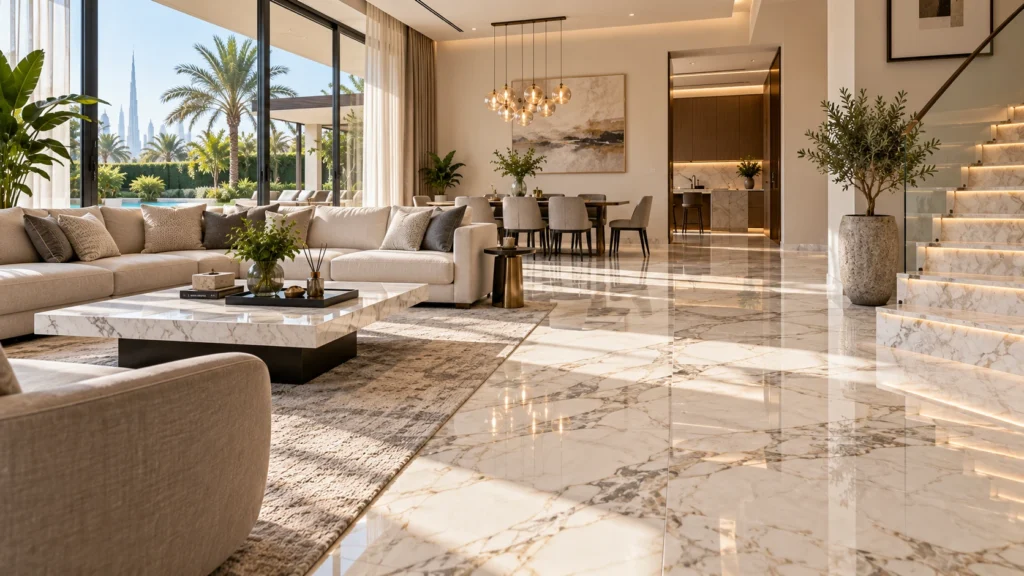
Polished Marble
Polishing creates a reflective surface that highlights the stone’s colour and veining. It can work beautifully in formal living rooms, entrance halls, and other interior areas where homeowners want a brighter, more refined appearance.
However, polished marble can show scratching, etching, and changes in appearance over time. The Natural Stone Institute notes that polished marble is prone to scratching, etching, and oil staining from common household products.
Honed Marble
Honed marble has a less reflective, more matte appearance. Some homeowners prefer it for contemporary interiors because it produces a softer visual effect. The right choice depends on the stone, room, expected traffic, maintenance preferences, and required surface characteristics.
For areas exposed to water, discuss slip characteristics and application suitability with the stone supplier and contractor rather than assuming every marble finish behaves the same way.
Is Marble Suitable for Dubai Bathrooms?
Marble can work in bathrooms when the selected stone, finish, and installation system suit the location. The Natural Stone Institute states that many marbles are suitable for wet-area applications, including showers and tub decks.
However, bathrooms add extra considerations.
You need to think about:
- Water exposure
- Drainage
- Surface finish
- Waterproofing beneath relevant finishes
- Cleaning products
- Grout and joints
- Slip considerations
- Ongoing maintenance
Marble’s calcium carbonate composition also makes it sensitive to acids. That matters because some household cleaners contain acidic ingredients that can dull or etch the surface.
In other words, buying beautiful marble and then attacking it every weekend with the wrong cleaner is not an ideal maintenance strategy.
Is Marble Good for Kitchens?
Marble flooring can also work in kitchens, but homeowners should understand its maintenance characteristics. Food preparation areas introduce oils, spills, and acidic substances. Lemon juice, vinegar, and other acids can affect calcite-based marble.
The Natural Stone Institute recommends mild, non-acidic cleaners for calcareous stone and warns that products containing acids such as lemon or vinegar can dull or etch these materials. For kitchen floors, prompt cleaning is important.
Do not leave spills sitting unnecessarily. If you are planning a wider kitchen renovation in Dubai, choose the flooring alongside cabinetry, worktops and other finishes so that colours and floor levels work together.
Does Marble Need Sealing in Dubai?
Sometimes but not every stone needs the same treatment. This distinction matters. It is common to hear blanket advice such as “all marble must be sealed every year.” That is too simplistic.
The Natural Stone Institute explains that sealing can provide additional stain resistance for some natural stones but does not make stone stain-proof. It also recommends consulting the stone supplier or sealer manufacturer regarding whether sealing is appropriate and how often a product should be applied.
Its technical resources also note that some natural stone benefits from sealing while other stone may be better left untreated, depending on the material and application.
Therefore, ask your installer:
- What exact marble are you installing?
- Does the supplier recommend sealing?
- Which sealer is suitable?
- Will it affect the appearance?
- What maintenance does the manufacturer recommend?
Specific answers are better than universal rules.
Can Dubai’s Sunlight Affect Marble?
Sunlight is another reason indoor and outdoor marble should not be treated as the same application. A living-room floor behind glazing experiences very different conditions from an uncovered outdoor terrace. Exterior stone faces direct solar exposure, weather, moisture, airborne dirt, and greater temperature changes.
The Natural Stone Institute notes that weathering elements can affect exterior marble and says exterior applications are generally limited to white marbles, with exceptions. That makes material selection particularly important outdoors. Do not choose exterior marble simply because you liked the sample under showroom lighting.
Ask whether that specific stone is suitable for the intended exterior application.
Is Marble Suitable for Outdoor Areas in Dubai?
This requires more caution than indoor installation.
Outdoor areas can include:
- Entrances
- Terraces
- Balconies
- Pool surrounds
- Garden paths
- Exterior stairs
These locations may face direct sun, moisture, sand, and greater surface contamination. Surface finish also becomes especially important where water is present.
Dubai Municipality’s Al Sa’fat green-building certification framework specifically addresses hardscape materials in relation to Solar Reflective Index, showing that exposed exterior surfaces form part of Dubai’s broader heat-management considerations.
That does not mean every marble floor needs a particular certification. It does reinforce a useful principle: outdoor materials should be selected according to their actual exposure and application rather than purely for appearance.
For exterior marble, obtain technical guidance for the specific stone, finish, and location.
How Important Is Marble Installation?
Very. You can purchase beautiful marble and still get disappointing results if installation is poor. Professional marble flooring installation in Dubai should consider factors such as:
Surface Preparation
The substrate needs appropriate preparation for the installation system.
Layout
Natural veining varies from piece to piece.
Planning the layout before permanent installation helps create a more intentional visual flow.
Levels
Poorly controlled floor levels can affect transitions, doors, and adjoining rooms.
Cutting
Edges, corners, and junctions require careful finishing.
Joints
The installation needs suitable joint planning based on the system and project requirements.
Protection
Newly completed marble should receive appropriate protection while other renovation trades continue working nearby. Installing marble beautifully and then allowing construction workers to drag tools across it would be a rather creative way to waste money.
How Should You Clean Marble Floors in Dubai?
A simple routine is usually better than aggressive cleaning. The Natural Stone Institute recommends cleaning natural stone with a neutral cleaner, stone soap, or mild liquid dishwashing detergent and warm water, following relevant manufacturer instructions.
For Dubai homes, a practical routine can include:
- Remove sand and loose grit regularly.
- Use entrance mats to reduce abrasive particles.
- Clean using products appropriate for natural stone.
- Avoid acidic cleaners unless specifically confirmed suitable.
- Blot spills rather than spreading them.
- Follow the marble supplier’s care instructions.
- Seek professional restoration for deeper scratches or serious etching.
Do not assume that a stronger cleaner means a cleaner floor. With marble, it can sometimes mean a cleaner floor plus a newly damaged finish.
Can Damaged Marble Be Restored?
One advantage of natural stone is that certain surface problems may be professionally addressed. The Natural Stone Institute advises that deeper scratches and nicks should be repaired and repolished by a professional and that etched areas may also require professional refinishing or repolishing.
Restoration possibilities depend on the stone and damage, so inspection is important. Common professional services may include cleaning, polishing, and restoration work where appropriate. This can make marble attractive for homeowners who value natural materials and accept periodic maintenance.
Marble vs Porcelain Tiles for Dubai Homes
Neither material wins every project.
| Factor | Marble | Porcelain Tile |
|---|---|---|
| Material | Natural stone | Manufactured ceramic product |
| Pattern | Naturally varied | Controlled/manufactured |
| Appearance | Distinctive natural veining | Very wide design range |
| Acid sensitivity | Marble is sensitive | Generally less of a concern |
| Maintenance | Requires stone-aware care | Often simpler |
| Restoration | Some marble surfaces can be refinished | Different repair approach |
| Selection | Individual pieces vary | More consistent between pieces |
Choose marble when natural character matters and you are comfortable with appropriate maintenance. Consider porcelain when you prioritise consistency and simpler everyday care. The decision should match the household rather than whichever material happens to be fashionable this month.
Where Does Marble Flooring Work Best?
For many Dubai homes, marble can be particularly attractive in:
- Villa entrance halls
- Living rooms
- Dining areas
- Corridors
- Staircases
- Bedrooms
- Selected bathrooms
- Formal reception spaces
Large continuous areas can showcase natural veining particularly well. Marble also works with many Dubai interior styles, from contemporary minimalism to more decorative villa interiors.
For complete residential projects, flooring choices should coordinate with the wider home renovation in Dubai or villa renovation in Dubai plan.
What Affects Marble Flooring Cost in Dubai?
There is no single price for every marble installation.
Cost can vary according to:
| Cost Factor | Why It Matters |
|---|---|
| Marble variety | Different stones have different supply costs |
| Stone dimensions | Size can affect material and installation |
| Quantity | Larger spaces require more material |
| Existing flooring | Removal may add work |
| Substrate condition | Preparation requirements vary |
| Layout complexity | Detailed patterns need more planning and cutting |
| Stairs and edges | Require additional finishing |
| Surface finish | Processing requirements vary |
| Installation | Site conditions affect labour |
| Polishing/protection | Depends on agreed finishing scope |
A site inspection and material selection provide a better foundation for a quotation than an arbitrary price per square metre pulled from the internet.
How to Choose Marble Flooring for a Dubai Home
Before ordering stone, ask practical questions.
Where will it go? Indoor living rooms and exposed terraces have different requirements.
What marble is it? Natural stones differ in appearance and physical characteristics.
Which finish suits the area? Polished and honed surfaces provide different aesthetics and practical characteristics.
What maintenance does it require? Ask before purchasing, not six months later.
Is sealing recommended? Follow guidance for the specific stone and product.
Who will install it? Layout and workmanship strongly influence the final appearance.
How will construction traffic be controlled? Protect completed flooring during renovation.
These questions help move the decision beyond “this sample looks nice.”
Why Choose Alaizal Technical Services for Marble Flooring in Dubai?
Alaizal Technical Services provides marble flooring services in Dubai as part of residential renovation and finishing work. For villas, apartments, and other homes, flooring needs to coordinate with existing levels, doors, walls, cabinetry, and other finishes.
That becomes especially important during complete renovations where several trades share the same site. A site inspection allows the existing floor condition, project area, selected material, and installation requirements to be reviewed before preparing the final scope and quotation.
Final Verdict:
Yes, marble flooring can be an excellent option for Dubai homes, particularly for indoor spaces, provided homeowners choose the right stone and finish, use professional installation, and maintain the surface correctly. Dubai’s climate does not automatically make marble unsuitable. The more relevant concerns are the actual installation location and exposure.
Indoors, pay attention to sand and grit, cleaning products, traffic, and maintenance. In wet areas, consider the finish, water exposure, and installation system. Outdoors, be more selective because direct sunlight and weather create additional demands.
Marble rewards good decisions. Choose it because it suits your space and lifestyle, not simply because a showroom floor looked impressive. Although, admittedly, showroom floors are very good at their job.
Frequently Asked Questions
Is marble flooring suitable for Dubai’s hot weather?
Yes, marble can work well as indoor flooring in Dubai. Indoor installations operate in a much more controlled environment than exterior stone. The suitability of the specific marble, finish, and installation remains important.
Does marble stay cool in Dubai?
Marble can feel relatively cool underfoot, especially inside air-conditioned homes. However, flooring alone does not control indoor temperature; the building envelope, glazing, insulation, and AC system also influence thermal comfort.
Does Dubai sand damage marble flooring?
Sand and grit can act as abrasives on natural stone. The Natural Stone Institute recommends entrance mats and frequent removal of grit to help protect stone floors.
Is polished or honed marble better for Dubai homes?
Neither is universally better. Polished marble provides a reflective finish, while honed marble offers a softer appearance. Choose according to location, expected traffic, maintenance needs, and appropriate surface characteristics.
Does marble flooring need sealing?
Some marble may benefit from an appropriate impregnating sealer, while requirements vary by stone and application. Sealing increases stain resistance but does not make marble completely stain-proof.
Can I use vinegar to clean marble floors?
It is not recommended. Marble is calcareous and sensitive to acids. The Natural Stone Institute warns that vinegar, lemon, and other acidic products can dull or etch calcareous natural stone.
Can marble flooring be restored?
Depending on the condition, certain scratches, etching, and surface wear may be addressed through professional refinishing or repolishing. More serious damage should be assessed by a stone professional.
Is marble suitable for outdoor flooring in Dubai?
Some marble can be used outdoors, but exterior exposure requires more careful material and finish selection. The Natural Stone Institute notes that weathering affects exterior marble and that exterior marble applications are generally limited to white marbles, with exceptions.
Considering Marble Flooring for Your Dubai Home?
The right marble depends on more than colour and veining. Existing floor conditions, installation area, finish, layout, and maintenance expectations should all be considered before work begins.
Request a free site inspection from Alaizal Technical Services and get a clear quotation for marble flooring in Dubai.
Call or WhatsApp: +971 56 787 9063
