

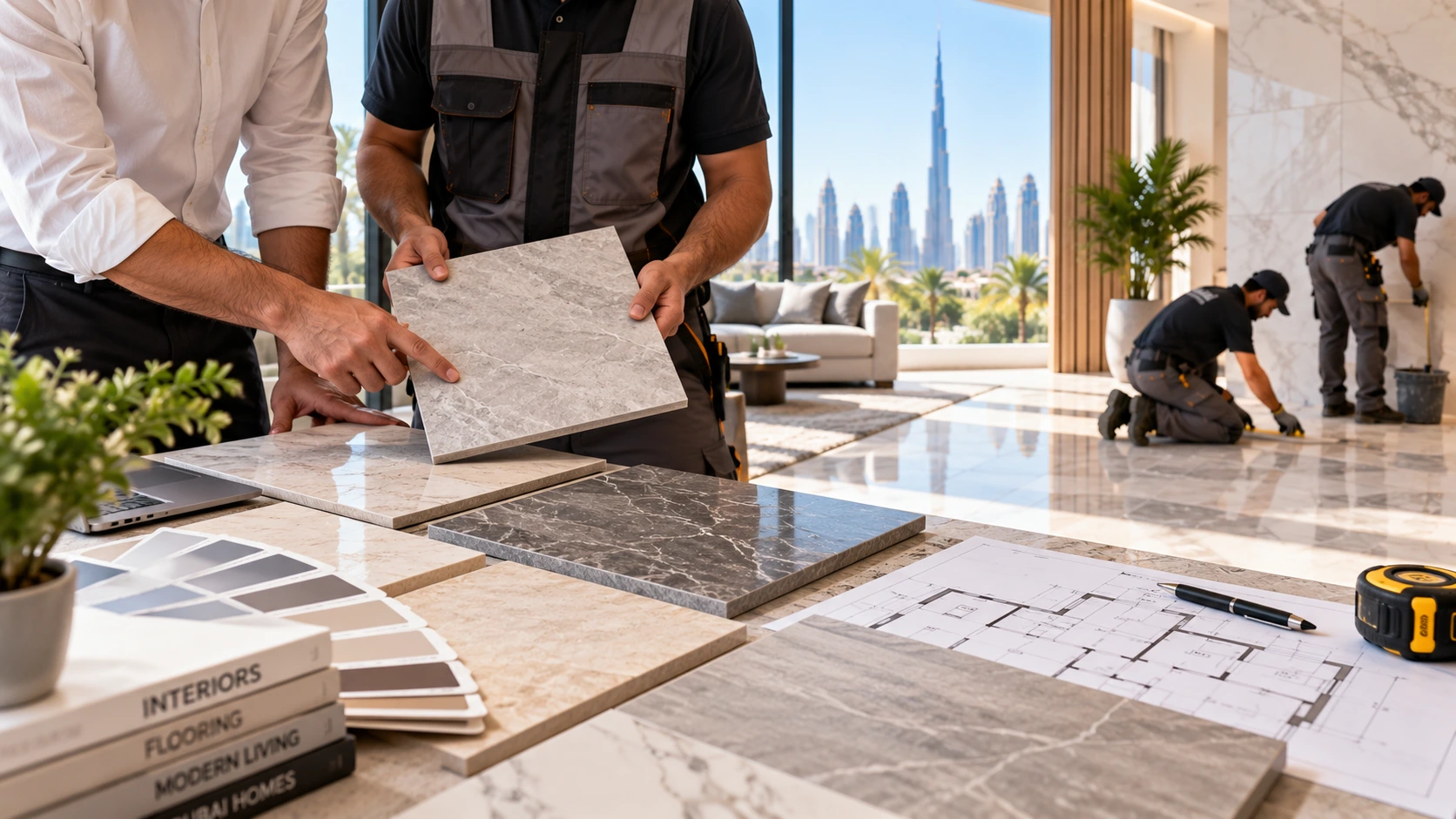
For homeowners planning tile installation in Dubai, appearance certainly matters. But the right tile also needs to suit the room, expected traffic, exposure to water, and installation conditions. Choosing tiles sounds simple until you walk into a showroom. Suddenly, you are comparing porcelain with ceramic, polished with matte, marble-look with stone-look, 600 mm tiles with enormous slabs—and somehow you have been discussing beige for 45 minutes.
A beautiful bathroom tile may not make sense for an outdoor entrance. A highly decorative kitchen wall tile does not automatically belong on the floor. Installation matters just as much. The Tile Council of North America’s 2026 installation handbook covers product selection, wet areas, substrate flatness, mortar and grout specifications, joint sizes and installation methods. That alone tells us something important: successful tiling involves far more than sticking tiles to a floor.
Here is how to make a more informed choice for a Dubai property.
What Should You Consider Before Choosing Tiles in Dubai?
Start with the location.
Ask:
- Is the tile for a floor or wall?
- Will the area regularly get wet?
- Is it indoors or outdoors?
- How much foot traffic will it receive?
- What is the condition of the existing surface?
- Does it connect with another flooring material?
- How much cleaning and maintenance do you want?
- Does the tile manufacturer recommend it for that application?
These questions narrow the options much faster than colour alone. A tile should work technically first and aesthetically second. Fortunately, you are allowed to demand both.
Ceramic vs Porcelain Tiles: What Is the Difference?
Ceramic and porcelain both belong to the ceramic tile family, but products differ in composition, manufacturing and performance characteristics.
Ceramic Tiles in Dubai
Ceramic tiles come in a wide range of colours, patterns and formats. Depending on the product specification, they can work well for residential walls and suitable floor applications. Wall tiles can be particularly useful for kitchens and bathrooms because manufacturers offer extensive decorative options.
Porcelain Tiles in Dubai
Porcelain is another ceramic tile category and is widely available in finishes that imitate stone, marble, concrete and timber. Do not choose a tile simply because the salesperson calls it porcelain, however. Look at the actual product’s technical information and recommended applications.
Industry standards exist specifically to provide quality criteria for ceramic tile selection. ANSI A137.1, for example, covers specifications and testing for ceramic tiles, including a method related to the dynamic coefficient of friction. The practical rule is simple: choose the specification for the application, not just the category name.
Which Tiles Work Well for living rooms in Dubai?
Living rooms usually need a combination of durability, easy maintenance and visual continuity. Large-format tiles have become popular in contemporary interiors because fewer grout lines can create a cleaner visual effect. Stone-look, marble-look and warm neutral finishes can work particularly well in Dubai villas and apartments. Before choosing an oversized format, however, discuss installation requirements.
Larger tiles can place greater emphasis on substrate flatness and careful installation. The TCNA installation handbook specifically addresses substrate flatness, grout joints and installation specifications. Tile dimensions should also make sense for the room. A large tile can look impressive in an open villa living area. In a tiny room full of corners, it may create more cuts and waste without delivering the same visual benefit.
Bigger is not automatically better. Sometimes it is simply bigger.
How Should You Choose Bathroom Tiles?
Bathrooms need more technical consideration because water changes the equation. Floor and wall tiles do not necessarily require the same characteristics.
For bathroom floors, consider:
- Suitability for wet environments
- Surface characteristics
- Cleaning requirements
- Tile dimensions
- Drainage layout
- Grout joints
- Shower floor design
- Manufacturer recommendations
Slip considerations deserve particular attention. The Tile Council of North America publishes ANSI A326.3 as a standard test method for measuring the dynamic coefficient of friction of hard-surface flooring materials.
That does not mean homeowners should select bathroom flooring from one number alone. The complete installation, intended use, surface condition, cleaning and water exposure all matter. For shower areas, tile dimensions may also need to work with drainage falls.
Your contractor should plan these details before installation begins. A bathroom floor’s first job is not winning compliments. It is functioning as a bathroom floor.
What Tiles Should You Choose for a Kitchen in Dubai?
Kitchen tiles need to handle everyday life. That includes foot traffic, spills, cooking mess and regular cleaning.
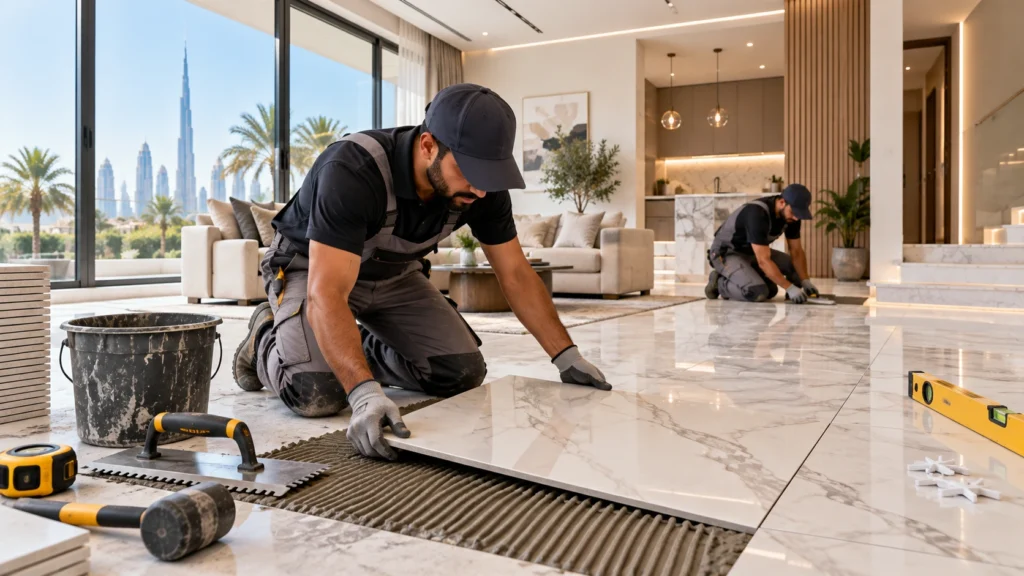
For kitchen floors, homeowners should consider:
- Ease of maintenance
- Suitability for floor use
- Surface texture
- Colour and pattern
- Grout colour
- Connection with adjacent flooring
- Compatibility with cabinetry
Very pale grout may look excellent when freshly installed but can demand more attention in a busy cooking area. Tile colour also needs to work with the entire kitchen rather than being chosen in isolation. If you are planning a fullkitchen renovation in Dubai, select flooring alongside the cabinets, worktop and wall finishes. This also allows the contractor to coordinate finished floor levels before cabinetry and doors create complications.
Are Marble-Look Tiles a Good Alternative to Natural Marble?
They can be, depending on what you want from the floor. Marble-look porcelain tiles aim to reproduce the visual character of natural stone while remaining a manufactured ceramic product. Natural marble, on the other hand, offers genuine variation from piece to piece. Neither option is automatically better.
Choose natural marble when you value authentic stone, natural veining and its distinctive material character. Choose an appropriate marble-look tile when you prefer a more controlled pattern or want the characteristics of a ceramic product.
If genuine stone is your preference, Alaizal Technical Services also provides marble flooring services in Dubai. Compare actual samples rather than online photographs. Your phone screen is very useful. It is not a flooring showroom.
What About Tiles for Balconies and Outdoor Areas?
Exterior tile selection needs greater care. Dubai’s outdoor surfaces can face strong solar exposure, airborne dust, water and temperature changes. An indoor tile should not automatically move outside simply because you have leftovers. Check whether the manufacturer specifies the product for the intended exterior application.
For balconies, entrances and other exposed areas, consider:
- Exterior suitability
- Surface characteristics
- Water exposure
- Drainage
- Substrate
- Installation system
- Movement accommodation
- Cleaning and maintenance
Poolside and other frequently wet locations need particularly careful selection.
The broader Dubai Building Code sets minimum requirements around health, safety, welfare and sustainable building design, reinforcing the importance of treating building materials as part of an overall technical system rather than purely decorative choices.
Does Tile Size Matter during Tile Installation in Dubai?
Absolutely. Tile size affects appearance, layout, cutting and installation.
Large-Format Tiles
These can make open interiors feel visually continuous and reduce the number of grout lines. They work particularly well with minimalist interiors and stone-look finishes. However, large-format installation demands careful surface preparation and handling.
Medium-Format Tiles
These offer flexibility across many residential rooms and can be easier to plan around smaller spaces.
Small Tiles and Mosaics
These can work well for details, niches, decorative areas and certain shower applications. More joints also mean more grout to maintain. Before ordering, ask the contractor to assess the room dimensions and proposed layout.
A good layout avoids awkward narrow cuts where possible and considers how tile lines meet walls, doors, cabinets and other architectural features.
Why Is Surface Preparation Important?
Tiles are the visible layer. What sits underneath them matters enormously. A substrate needs to be appropriate for the specified tile installation system. Existing conditions may require cleaning, levelling, repair or other preparation before installation.
The TCNA’s current handbook explicitly covers substrate requirements and installation methods for ceramic, glass and stone tiles. Ignoring the substrate because “the tiles will cover it anyway” is poor logic. Paint also covers a wall. That does not make cracks disappear. Professional tile contractors should inspect the surface before confirming how installation will proceed.
What Is the Tile Installation in Dubai Process?
The exact process depends on the tile, substrate, room and specified installation system, but a residential project generally requires several coordinated stages.
1. Site Inspection
The contractor examines the existing floor or wall, dimensions and site conditions.
2. Material Selection
The homeowner confirms the tile and related finishing requirements.
3. Removal and Preparation
Existing flooring may need removal, followed by appropriate substrate preparation.
4. Layout Planning
The installer plans tile direction, starting points, joints and cuts.
5. Installation
Tiles are installed using an appropriate system based on the product and substrate requirements.
6. Grouting and Finishing
Joints receive the specified grout after the installation reaches the appropriate stage.
7. Cleaning and Inspection
The contractor checks alignment, joints, edges and overall finish.
8. Protection
If other renovation trades remain on site, completed floors need suitable protection. A finished floor should not become a convenient storage area for ladders, paint buckets and everybody’s toolbox.
How Do You Choose Grout Colour For Tile Installation in Dubai?
Grout can either blend with the tiles or deliberately create contrast. Matching grout usually produces a quieter, more continuous appearance. Contrasting grout makes the tile pattern more visible. Consider maintenance, too. Floor grout in high-traffic areas experiences different conditions from decorative wall grout.
The joint width should not be selected solely for appearance. Tile dimensions, variation, layout and installation requirements also influence joint planning. This is another area covered by recognised tile installation guidance. Ask your installer to show you how the selected grout looks beside the actual tile before committing across the entire property.
Do You Need Approval to Replace Tile Installation in Dubai?
Requirements depend on the property, jurisdiction, and scope. Do not assume every flooring replacement needs the same approval process. Within the Dubai Development Authority’s jurisdiction, Circular 318 states that flooring replacement that does not affect or damage structural elements can fall outside its Fit-Out Permit requirement, subject to the conditions in that circular and landlord/facilities-management NOC or permit-to-work requirements.
For wider fit-out work, DDA’s current Fit-Out Permit process can require documents including an owner NOC, relevant authority NOCs, and approved/proposed drawings. Other properties and jurisdictions may follow different processes. For apartments especially, check with building or facilities management before demolition. Rules may cover contractor access, working hours, waste handling, lifts and other site arrangements.
It is much easier to check first than to discover the rules after a pile of old tiles appears in the corridor.
What Affects Tile Installation Cost in Dubai?
There is no responsible single price for every project.
The quotation can depend on:
| Cost Factor | Why It Matters |
| Tile type | Products vary significantly in price |
| Tile dimensions | Handling and installation requirements differ |
| Area size | Affects material and labour quantities |
| Existing flooring | Removal may add work |
| Substrate condition | Repairs or preparation may be necessary |
| Layout | Patterns and detailed cuts require more work |
| Stairs | Add edges, cuts and detailing |
| Bathrooms | Wet areas involve additional considerations |
| Outdoor areas | Installation requirements can differ |
| Grout and finishing | Product and joint requirements vary |
| Site access | Logistics can affect execution |
Material cost is only one part of the quotation. A cheap tile installed badly is not a cheap floor. It is simply a future renovation arriving early.
Common Tile Installation in Dubai Mistakes to Avoid
Choosing Tiles Only by Appearance
Check intended use and technical information too.
Ignoring the Existing Surface
Poor preparation can undermine otherwise good materials.
Forgetting Wet-Area Requirements
Bathrooms, showers and outdoor wet areas deserve application-specific planning.
Buying the Exact Measured Area
Cuts, layout and replacement considerations can affect the required quantity. Your contractor or supplier should calculate an appropriate order based on the actual project rather than relying on a universal waste percentage.
Ignoring Floor Levels
New flooring can affect doors, thresholds and transitions into adjoining rooms.
Starting Without a Layout
Planning before installation helps avoid awkward cuts and poorly positioned patterns.
Leaving Flooring Unprotected
Renovation work continuing after tile installation can damage completed surfaces.
How to Choose a Contractor For Tile Installation in Dubai
Before hiring, ask practical questions. Does the contractor inspect the existing floor? Will they explain the preparation required? Can they coordinate tile installation with plumbing, carpentry and other renovation work? Who plans the layout?
How will the finished flooring be protected? What exactly does the quotation include? For a wider home renovation in Dubai or a villa renovation in Dubai, flooring should form part of the overall project sequence. That helps coordinate tile levels with kitchens, doors, bathrooms, skirting, painting, and custom carpentry.
Why Choose Alaizal Technical Services?
Alaizal Technical Services handles flooring and finishing work as part of residential and commercial renovation projects in Dubai. The process can begin with a site inspection to understand the existing surface, required area, tile selection and surrounding renovation work.
This is particularly useful when flooring forms part of a larger project involving kitchens, bathrooms, painting, carpentry or MEP modifications. For general project requirements, explore Alaizal Technical Services’ renovation and technical services.
Final Thoughts
Successful tile installation in Dubai starts before the first tile reaches the floor. Choose tiles according to the room, exposure, traffic and maintenance requirements. Check technical information rather than relying entirely on appearance. Plan wet areas carefully. Inspect and prepare the substrate properly. Then give equal attention to layout, joints and finishing.
For Dubai properties, also confirm any building-management or authority requirements that apply to the actual work. The right tile should still look good several years after the showroom excitement disappears. And if you spend an hour deciding between “warm ivory” and “soft ivory,” do not worry. That appears to be a standard part of renovation.
Frequently Asked Questions
Which tiles are best for Dubai homes?
There is no single best tile for every Dubai home. The right product depends on whether it will be used indoors or outdoors, on a wall or floor, in a dry or wet area, and how much traffic it will receive.
Are porcelain tiles suitable for Dubai homes?
Many porcelain products can suit residential floors and walls, but homeowners should check the manufacturer’s technical specification and intended application for the exact product rather than relying on the porcelain label alone.
Which tiles should I use in a bathroom?
Choose tiles specified for the intended bathroom application and pay particular attention to wet-area suitability, surface characteristics, drainage, cleaning and installation requirements.
Are large-format tiles good for villas?
Large-format tiles can create a clean, continuous appearance in spacious villa interiors. They also require appropriate substrate preparation, layout planning and professional installation.
Can I install indoor tiles outdoors?
Do not assume an indoor tile suits exterior use. Outdoor areas face different exposure conditions. Check the manufacturer’s intended application and discuss tile installation in Dubai with your contractor.
Do I need permission to replace flooring in Dubai?
Requirements vary according to the property, jurisdiction and scope. In some circumstances flooring replacement may not require a full fit-out permit, while landlord or facilities-management approval may still apply. Check the requirements for the specific property before work starts.
How much does tile installation in Dubai Cost?
The final price depends on tile selection, area, existing flooring, substrate condition, tile dimensions, layout, cutting, wet-area requirements and other project details. A site inspection and defined material specification provide a better basis for quotation.
Why is substrate preparation important before tiling?
The substrate supports the tile installation. Flatness, condition and compatibility with the selected installation system can influence the quality of the finished work. Recognised tile installation guidance specifically addresses substrate requirements.
Planning Tile Installation in Dubai?
Choosing the tile is only part of the job. Existing floor conditions, layout, preparation, installation and coordination with other renovation work all affect the finished result.
Request a free site inspection from Alaizal Technical Services and get a clear quotation for your flooring or renovation project in Dubai.
Call or WhatsApp: +971 56 787 9063
